

When To Use AI vs Humans
[ad_1]
In the ever-evolving world of web design and development, the question often arises: should we rely on artificial intelligence or human expertise? Let’s explore the scenarios where each comes in handy.

[ad_1]
In the ever-evolving world of web design and development, the question often arises: should we rely on artificial intelligence or human expertise? Let’s explore the scenarios where each comes in handy.

[ad_1]
The race to get your hands on the season’s hottest toys has officially begun. Teaming up this festive period, Macy’s and Toys“R” Us have unwrapped Geoffrey’s Hot Toy List for 2023. This coveted list is a holiday tradition that brings joy and excitement to gift givers and receivers alike. And for small businesses looking for potential inventory ideas or to anticipate holiday shopping trends, this list is your key to the season’s demands.
In 2023, toys from iconic brands such as Barbie, Hot Wheels, Pokémon, and LEGO make the list, offering something for every age. Unique to this year is the inclusion of a Toys“R” Us global exclusive: the Geoffrey with a Globe FUNKO. Shoppers can also anticipate exclusive in-house brands like Fast Lane, You & Me, and True Heroes.
The retail collaboration between Macy’s and Toys“R” Us isn’t just for the holidays. Toy enthusiasts can indulge year-round, as Toys“R” Us has established its presence in every Macy ’s-branded store throughout the nation. For the digital-savvy, both macys.com and toysrus.com, including the Macy’s app, have a diverse toy inventory available from the Hot Toy List, which is supplemented with user-friendly online gift guides.
Macy’s resident toy expert, Adeline Trento, expressed the company’s enthusiasm. “We are thrilled to bring Geoffrey’s Hot Toy List for the 2023 holiday season to our customers with unique Toys“R” Us experiences for kids of all ages to explore and discover all of these fun toys at Macy’s stores across the country,” she said.
Among the must-haves on Geoffrey’s Top Toys List for 2023 are:
For the social media savvy, Toys“R” Us is also hosting a Geoffrey’s Hot Toys List sweepstakes. From September 26th to October 6th, U.S. residents can engage with the Hot Toy posts on Instagram for a chance to win. Each day, a toy from the top 10 list will find a new home, with a grand prize winner snagging all ten! Winners will be announced on October 13th.
From mid-October, Macy’s stores are turning festive with Geoffrey’s Birthday In-Store Celebrations. These offer interactive events, free giveaways, and even a “Geoffrey on a Bench” photo opportunity for families.
For small business owners, this partnership and its product list offer valuable insight into holiday consumer trends and popular items.
Follow us for more Small Business News:
Image: Envato Elements
[ad_2]
Source link

[ad_1]
Starting a dropshipping business is an excellent way to dip your toes into the world of entrepreneurship. You can sell products directly to customers, set your own pricing, and even market under your own brand. You don’t even need to pay for inventory until a product has been sold to an actual customer. With dedication and hard work, you have the potential to build a successful brand.
If you’re hesitant about launching your online venture, consider this: In 2023, an estimated 218.8 million US consumers will shop online, and ecommerce sales are expected to make up 20.8% of retail sales globally. Given these statistics, launching an online store appears to be an increasingly lucrative option.
In this article, we’ll cover everything you need to know about starting a dropshipping business, from understanding what it is to finding the right dropshipping suppliers and more.



Dropshipping is a business structure that allows you to operate your store without holding any inventory. Once you’ve made a sale, your supplier will ship the products from their warehouse directly to your customer’s doorstep. This eliminates the hassle of storing, packaging, and shipping products yourself.
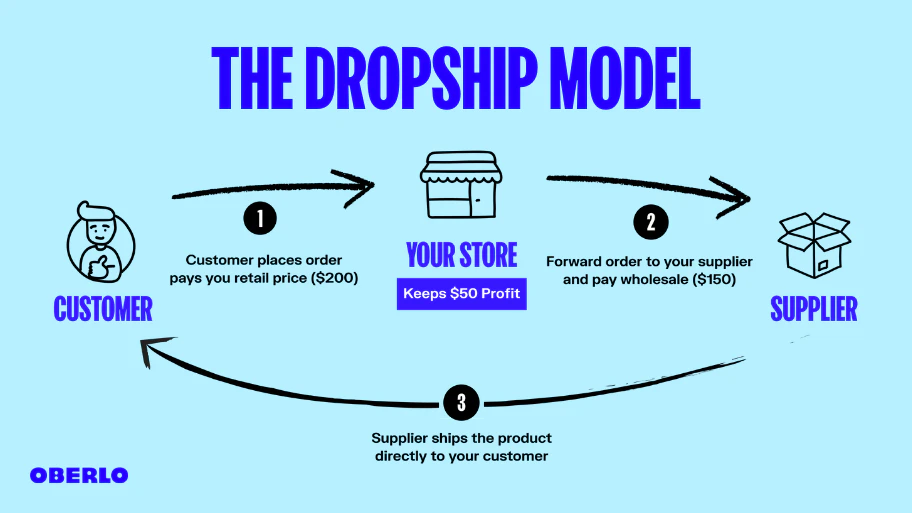
There are three key players in dropshipping: the manufacturer, the retailer (you), and the customer.
The manufacturer’s role includes creating products, maintaining inventory, shipping products to customers on behalf of the retailer, replacing defective items, and restocking. They sell products to the retailer at wholesale prices, thereby assuming the risk of any unsold inventory.
As the retailer, you sell the manufacturer’s products on your own website under your brand name. You are responsible for selecting and marketing the products. Additionally, you handle the shipping costs and set prices that yield a profit.
Finally, in this model, the customer purchases goods directly from you. If any questions or issues arise, they will turn to you, the retailer with whom they’ve done business.
“How profitable is dropshipping is a question we hear often. Dropshipping can be highly profitable because you’re not saddled with the costs of shipping and manufacturing. Profits can accumulate quickly, especially when you’ve partnered with the right dropshipping suppliers. To keep tabs on your earnings and ensure you’re on the path to success, consider using our dedicated profit margin tool.
A dropshipping business is a profitable business model where you only pay for the products that you sell. This means you’re not burdened with the cost of creating products or carrying inventory. As such, the startup costs of running a dropshipping store are quite low compared to those that come with operating a standard ecommerce business.
In this business model, you also avoid the costs of maintaining unsold inventory and employing staff for packaging and shipping products. While it will require daily work when it comes to processing orders, most of the order processing steps are automated and only require the click of a button. The dropshipping business opportunities are endless—you just need to take the first step.
The right niche is crucial for a dropshipping business’s success. While having a passion for a chosen market helps, profitability remains the primary goal. Evergreen niches like fitness, fashion, jewelry, beauty, tech, purses, and backpacks continually draw successful online stores. For instance, entrepreneur Tim Kock found success with a watch business. He generated nearly $7,000 in only eight weeks, highlighting the importance of choosing a profitable niche.

There are a few tools and tactics you can use to find niches for your own dropshipping business:
Google Trends can show if a niche is gaining or losing popularity. However, it can’t confirm a niche’s viability on its own, as some trending niches may lack sufficient search volume.
This tool reveals the search volume and competitiveness of keywords. Using this data, you can assess the potential of dropshipping business ideas and gain future direction.
Additionally, you can visit popular websites within your target niche to gather information. Fashion retailers, for example, often categorize their products based on current trends. Use this strategy to determine which products to add to your store. Also, review a store’s bestselling items to identify profitable products to offer.
Pro tip: The most popular dropshipping stores often focus on trends within broader niches. For instance, denim apparel is a trend within the fashion niche, artificial eyelashes are a trend within the beauty niche, and marble phone cases are a trend within the phone case niche. It’s wise to incorporate these trends into your product lineup. However, they shouldn’t be the focus of your entire store if you aim for long-term success.

Once you have decided what to sell, you now need to educate yourself on who your competitors are, what they sell, and how they sell their products. Market research is an essential part of this step, and there are many ways to do it.

It can be easy to find a good supplier on AliExpress, one of the most popular platforms for dropshipping companies. Once you’re on the platform, you can search for products and choose from a list of reliable suppliers based on reviews, ratings, and how long each supplier has been on the platform. This information should influence your decision on which supplier to choose in the dropshipping process.
After you’ve compiled a list of five or six potential suppliers, the next step is to contact them. Ask important questions like minimum order quantities and shipping times to better understand your profit margins.
By this point, you’ve probably narrowed down your list of potential suppliers from five to two or three. The best way to make your final decision is to place sample orders with these suppliers. Compare ecommerce shipping times, product quality, and packaging as you make your decision, always keeping your customer in mind. Consider what they will expect from you when placing an order.

There are a few components to building a dropshipping business store the right way:
Your domain name is especially important if you’re building a long-term brand. You can use a free business name generator to simplify the process. Always opt for a .com domain, regardless of your niche. If you want your niche to be a keyword in your new domain, make sure it’s broad—like “beauty,” “jewelry,” or “fashion”—rather than specific. This way, you won’t need to change your domain name down the road. Also, avoid using your own name as the domain for your store. If you ever decide to sell your business, you could legally lose the rights to your own name.
Shopify is the most comprehensive ecommerce platform on the market. With new features, tools, resources, and apps being added regularly, you’ll find it easy to run a business on the platform. Plus, if you get stuck, you can reach out to a Shopify expert who will personally walk you through any steps, free of charge.
Since we’re using Shopify, you can explore free themes. Minimal Motion is one such option. It’s clean and easy to navigate, making it an excellent choice for those new to store design. As you start generating some revenue, you can invest in a new theme. This will give your store a more polished design.
To manage your inventory and place orders efficiently, you’ll need a reliable dropshipping app. DSers is a solid option that allows you to find products online that you can sell the same day. This app lets you explore products in a variety of popular niches. When starting out, it’s advisable to focus on 10 to 25 products, as writing descriptions for a larger inventory can become overwhelming. If you have questions or need guidance, you can turn to the DSers blog, its social media pages, or Shopify’s own support line.
Need a step-by-step guide? Check out this article to learn how Tomas Slimas launched an online store in only 30 minutes.

At this stage, you’ve selected your product and set up your store. The next step is to aggressively market your dropshipping business.
This is a crucial component of any dropshipping business plan. For those just starting out and likely on a tight budget, it’s worth noting that effective marketing doesn’t have to be expensive. Here are some suggestions::
Resist the temptation to pour $500 into Facebook ads right away. Many new entrepreneurs think big returns will happen quickly, but they usually don’t. Start with a modest $20 ad spend to gauge effectiveness. If the first ad doesn’t yield conversions, don’t get discouraged. A low initial budget allows for valuable experimentation, especially when the bestselling product isn’t clear yet.
Create multiple ads to identify which product sells best. When setting up targeting options, craft a worldwide ad but exclude Canada, Australia, the United States, and the UK. This strategy keeps ad costs low. As the business scales or the budget expands, create targeted ads for these four countries individually.
If your budget is small, retargeting ads are a good option. These ads work well if your store has high traffic. You may already have high traffic from free marketing on Pinterest. Or maybe a blog post on your site is bringing in visitors. Retargeting ads can take this free traffic and turn it into sales. Compared to standard Facebook ads, they usually do a better job. Plus, they’re a lot cheaper.
In the early stages of a dropshipping business, budget constraints are common. If paying influencers isn’t an option, consider offering an affiliate commission instead. This reduces financial risks for your business and shifts the onus of sales conversion to the influencer. It also adds value by generating images or reviews that elevate your brand’s social proof. With an affiliate commission model, influencers can often earn more than they would with a flat fee, especially if they have an engaged audience.
To boost exposure for your ecommerce website, consider using HARO. This tool connects reporters with potential sources. By subscribing to their thrice-daily emails, you get a chance to be featured in articles. Some reporters look for expert opinions, while others seek product recommendations. Use this media attention to drive targeted traffic to your ecommerce website. For better results, link directly to specific product pages instead of the homepage. Pair this approach with retargeting ads to maximize potential sales.

Once you’ve spent time building your website, brand, and marketing, you can start to analyze the results of your hard work. You may find that certain marketing activities are hugely successful, while others not as much. You can also compare your prices to that of your competition and see if you could make things more competitive.
You can use tools like Google Search Console or Google Analytics to evaluate your online traffic and make sure it’s increasing, not decreasing. If you’re using third-party tools for email marketing or social media reporting, set up weekly or monthly automatic reports to remind you to analyze this information regularly. Even a quick snapshot of data from a tool can be enough to decide if a campaign is working or not.
Overall, the most important part of a successful online ecommerce store is to test and optimize. This ensures that your website will not fall behind best practices and keeps you ahead of your competitors.
Incorporating a dropshipping business has clear benefits. It separates your personal and business finances, protecting your money if the business runs into debt. Additionally, incorporating gets you an employer identification number (EIN), which makes it easier to file and pay sales tax. So if you’re planning for long-term success, think about incorporating. It’s a good way to manage your finances and taxes.
If you don’t want to build a Shopify dropshipping business from scratch, you can easily find a dropshipping business for sale on Flippa.
Flippa is a marketplace of websites for both people looking to invest in a fully functioning business and those who want to skip the building phase and start directly with marketing. Flippa has a great collection of online stores, including dropshipping ecommerce businesses, of varying price ranges and niches that you can choose from depending on your budget and interests.
So, if you’re looking for a dropshipping business for sale, Flippa has got you covered.

When choosing to buy a store, take into account the cost, the design, the age of the website, how much money it has made, the popularity of the niche, penalizations, and the type of business.
If you plan on buying a dropshipping business, you need to select the ecommerce filter on Flippa. Other options may require you to buy and hold inventory, which can cost more money over the long term, especially in unsold inventory.
Do you have a budget that covers not just the cost of a premade store but also allows for its growth? If so, you need to work out what your budget looks like. What price are you willing to pay for a business? Is there room to negotiate a better deal?
Does the store look like it was designed by a professional or by a new entrepreneur who’s looking to make a quick sale? If the store design looks professional, clean, and easy to navigate, it may be worth pursuing.
On Flippa, you can choose an ecommerce business based on its age. An older website will typically have a better chance of ranking online than a newer one.
Sometimes you’ll see that a store made a lot of money. However, a question you need to ask is, “How much money was it making at its peak, and how much is it making now?” This will help you understand if the dropshipping business is growing or dying.
You probably don’t want to be selling fidget spinners anymore, or any trending product. However, if a store is within an evergreen niche and sells trending products, it could work out well. Broad topics (beauty) tend to perform better than stores focused on a specific type of product (makeup brushes).
Before buying a dropshipping business you need to double check that the website hasn’t been penalized (removed from Google’s search index).. You can use a tool like Is My Website Penalized to determine if a website has been penalized by Google. If a store has been penalized it may be harder for you to rank in search engines. You also want to ask, “Were any of the business’s Facebook ads banned?”
The value of dropshipping depends on the time and money you invest in it. If you dedicate time to growing your online business, you are more likely to reap the rewards. Setting up a dropshipping business involves multiple steps: You need to set up a store, import products, decide on your pricing strategy, and start selling. All of this require effort and commitment for your business to be successful.
There you have it—everything you need to know about starting a dropshipping business. By applying the advice from this article to your own online store, you can work toward building your own online empire.
[ad_2]
Source link

[ad_1]
Data is the lifeblood of any organization. As such, we need to use it in the most trustworthy, ethical, and valuable ways to best serve our customers. As data regulations continue to shift, keeping up with and ensuring proper governance has become more critical and complex than ever before.


[ad_1]
Starting a private home care business presents an intriguing blend of opportunities. On one hand, entrepreneurs find themselves in a position to offer essential services that enhance the quality of life for many individuals. On the other hand, the venture opens the door to a potentially lucrative market ripe for innovation and growth.
Striking a balance between compassionate care and business acumen, a private home care business can serve as a rewarding entrepreneurial endeavor. Read on for a guide on how to start a private home care business.
The home healthcare industry has witnessed a surge in demand, particularly due to an aging global population. According to the World Health Organization, the number of people aged 60 years or older will rise to 1.4 billion by 2030.
This demographic shift presents both challenges and opportunities. While the need for specialized care increases, so does the potential for business growth.
However, the sector also faces challenges, including both regulatory hurdles and the need for highly skilled labor.
Despite these obstacles, the industry remains on an upward trajectory. According to a report by MarketsandMarkets, the global home healthcare market is estimated to be worth $226 billion in 2022 and is poised to reach $340.2 billion by 2027, growing at a Compound Annual Growth Rate of 8.5% from 2022 to 2027.
For those contemplating how to start a business in the home care industry, understanding the range of services offered is crucial.
Home health care encompasses a variety of services, from personal care to specialized medical treatments. The diversity allows entrepreneurs to tailor their offerings to meet specific community needs.
Personal care services focus on assisting individuals with daily activities such as bathing, dressing, and meal preparation. These services are essential for those who face challenges in performing these tasks independently, often due to age or disability.
Certified Nursing Assistants offer a higher level of care compared to personal caregivers. CNAs are trained and certified to perform tasks such as taking vital signs, administering medication, and assisting with mobility issues.
Physical and occupational therapy services aim to improve the physical abilities and quality of life of patients. Physical therapists focus on mobility and strength, while occupational therapists work on helping individuals perform daily activities more efficiently.
Home health aides provide basic medical care under the supervision of a registered nurse or a medical doctor. Services often include wound care, administering medication, and monitoring health conditions.
Medical home health care services are more specialized and require medical professionals such as registered nurses, physicians, and therapists. These services can include complex treatments like intravenous therapy, diabetic care, and post-surgical care.
Establishing a private home care business involves a series of foundational steps and considerations.
From understanding market dynamics to ensuring compliance with regulations, each stage plays a pivotal role in the success of the venture.
| Steps to Start a Private Home Healthcare Business | What the Step Entails | Why the Step is Important | Tips for Success |
|---|---|---|---|
| Understanding the Market | Assess local demand, identify competitors, and recognize unique needs of the target market. | Serves as the cornerstone for making informed business decisions. | Utilize market research tools and consult industry reports for accurate data. |
| Compliance, Licenses, and Certifications | Adhere to various rules, laws, and regulations. | Ensures the safety and well-being of clients and avoids legal repercussions. | Consult legal advisors and compliance officers for expert guidance. |
| Complying with Regulations | Monitor and update business practices to remain compliant with local, state, and federal laws. | Keeps the business within the confines of the law. | Regularly review and update compliance protocols. |
| Securing Necessary Licenses and Certifications | Acquire licensing, certifications, and insurance | Ensures legal operation and enhances credibility. | Keep all certifications up to date and readily available for inspections. |
| Crafting a Business Plan | Create a detailed plan outlining objectives, operational strategies, and financial projections. | Serves as a roadmap for business success. | Seek professional help for financial modeling and market analysis. |
| Hiring and Training Caregivers | Recruit qualified caregivers and provide continuous training. | Ensures high-quality care and compliance with regulations. | Implement rigorous background checks and ongoing training programs. |
| Safety Protocols and Patient Confidentiality | Establish safety measures and maintain patient data confidentiality. | Protects both clients and caregivers. | Regularly audit safety protocols and use secure data encryption methods. |
| Setting Up Billing and Payment Systems | Implement a reliable and secure billing system. | Ensures financial stability and accurate invoicing. | Choose a billing system tailored to healthcare needs. |
| Building a Brand and Marketing | Create a trustworthy brand and implement effective marketing strategies. | Drives customer acquisition and retention. | Utilize social media advertising and SEO optimization for greater reach. |
| Building a Client Base and Referral Network | Establish partnerships and engage in community and online advertising. | Diversifies the client base and enhances credibility. | Build relationships with healthcare providers for referrals. |
| Implementing Quality Assurance Processes | Conduct regular assessments and gather client feedback. | Improves the quality of care and identifies areas for improvement. | Use performance metrics for continuous monitoring. |
| Developing Client Contracts and Agreements | Draft clear contracts outlining services, costs, and expectations. | Provides a legal framework for the business relationship. | Always consult a legal advisor before finalizing contracts. |
| Considering an Administrative Office Space | Maintain an office for administrative tasks, staff training, and client meetings. | Enhances business credibility and provides a centralized location for operations. | Choose a location that is easily accessible and professional. |
Entrepreneurs must navigate through various complexities, including legal requirements, staffing, and marketing, to build a successful and sustainable business.

Before taking the plunge into this business, a thorough understanding of the local market is indispensable.
Entrepreneurs must assess local demand, identify competitors, and recognize any unique needs that the target market may have. Such knowledge serves as the cornerstone for making informed business decisions.
Market research can reveal valuable insights into customer preferences, pricing strategies, and potential challenges, thereby shaping the business model and offerings.

Operating a home healthcare business involves strict adherence to various rules, laws, and regulations. Compliance is not merely a legal requirement but a moral obligation to ensure the safety and well-being of clients. Failure to comply can result in severe penalties, including fines and revocation of licenses, which could jeopardize the business’s reputation and financial stability.
Navigating the intricacies of local, state, and federal regulations requires meticulous attention to detail. The healthcare industry is subject to a dynamic set of laws that can change frequently.
Therefore, continuous monitoring and updating of business practices are essential to remain compliant.
Legal advisors and compliance officers can provide invaluable assistance in this regard, ensuring that the business operates within the confines of the law.
Acquiring the necessary licenses and certifications is a critical step in establishing a home healthcare business.
The following are just a few credentials that not only to ensure compliance with laws and regulations but also enhance the business’s credibility and marketability.

Creating a comprehensive business plan is a pivotal step in establishing a home healthcare business.
A well-crafted plan outlines the business’s objectives, operational strategies, and financial projections, serving as a roadmap for success.
When creating your home health agency business plan, be sure to give attention to the following elements:

Recruiting the right caregivers is a critical step in establishing a successful home healthcare business.
Ensuring that staff members have the necessary qualifications and training complies with regulations and guarantees high-quality care for clients.
Recruitment should include rigorous background checks, interviews, and skill assessments.
Likewise, continuous training programs can keep the staff updated on the latest care techniques and industry best practices.

Establishing effective safety protocols and maintaining patient confidentiality are non-negotiable aspects of running a home healthcare business.
Measures such as the following protect both the client and the caregiver, ensuring a safe and secure service environment:

A reliable and secure billing system is crucial for the financial stability of a home health care business. It ensures timely and accurate invoicing, which is especially important when dealing with insurance companies and Medicaid.
When preparing to launch your own private healthcare company, consider the following popular billing systems:

Creating a trustworthy brand and implementing effective marketing strategies are vital for the growth and sustainability of a home healthcare business.
A strong brand image can significantly influence customer perception, while effective marketing can drive customer acquisition and retention.
Strategies to market and build your brand are practically endless, but a few tried-and-true options include:

Establishing a client base and referral network is crucial for the long-term success of a home healthcare business. Forming partnerships with hospitals, rehabilitation centers, senior centers, and other healthcare providers can provide a steady stream of client referrals.
Community engagement, online advertising, and participation in health fairs and community events also serve as effective strategies for client acquisition.
This multi-pronged approach diversifies the client base and enhances the business’s credibility and reach.
Online platforms and social media can further amplify these efforts, allowing the business to reach a broader audience and attract a diverse clientele.

Quality assurance is a critical aspect of any healthcare service.
Regular assessments, feedback mechanisms, and continuous training programs can significantly improve the quality of care provided.
Such processes allow the business to identify areas for improvement and implement corrective actions proactively. They also provide a framework for monitoring performance metrics, ensuring that the business meets its quality objectives consistently.

Clear and comprehensive contracts are essential for smooth business operations.
Contracts outline the scope of services, payment terms, and mutual expectations, providing a legal framework for the business relationship.
They serve as a safeguard against potential disputes, ensuring that both parties have a clear understanding of their roles and responsibilities.

While the core services are provided in the client’s homes, an administrative office can offer several advantages.
It serves as a centralized location for administrative tasks, staff training, and client meetings.
Having a physical office space can also enhance the business’s credibility, providing a professional setting for various business activities.
The client onboarding and assessment phase is crucial for establishing a strong foundation in a home healthcare business.
Gathering comprehensive information about the client’s medical history, preferences, and specific needs is essential during intake. This sort of data collection sets the stage for personalized care.
Understanding client needs goes beyond medical requirements; it encompasses lifestyle preferences, daily routines, and even family dynamics.
With this information in hand, creating individualized care plans becomes a more streamlined process. The plans serve as a roadmap for caregivers, ensuring each client receives the best care tailored to their unique needs.
Incorporating modern technology into the operations of a home healthcare agency has become increasingly important in this digital age.
Technological solutions offer many benefits ranging from improving the quality of care to streamlining administrative tasks.
Advanced systems not only make day-to-day operations more efficient but also serve as a unique selling point.
Clients who prioritize high-quality, technologically advanced care will find such features appealing, thereby giving the agency a competitive edge in the market thanks to tools such as the following:
Quality assurance is an indispensable component of home healthcare services.
Regular audits, client feedback, and caregiver evaluations are some of the mechanisms that contribute to maintaining high standards. These tools provide valuable insights into areas that may require adjustments or improvements.
Timely interventions based on these insights can significantly enhance the quality of care, thereby ensuring client satisfaction and long-term business sustainability.
In the home healthcare market, ethical considerations hold paramount importance. Upholding the principles of client confidentiality and patient autonomy are foundational to the agency’s operations.
Beyond ethical considerations, cultural sensitivity is another crucial aspect. The ability to understand and respect diverse cultural, religious, and personal preferences ensures that the care provided is holistic, considerate, and tailored to meet individual needs.
Given the emotionally demanding nature of caregiving, employee well-being cannot be overlooked. Agencies must offer supportive work environments, regular training, and mental health resources to retain qualified, committed caregivers.
Economic downturns pose a significant challenge to businesses across sectors, and home healthcare agencies are no exception.
Planning for such contingencies is crucial for ensuring the agency’s survival and continued growth. A well-thought-out strategy can serve as a buffer against financial instability, allowing the business to navigate through challenging times effectively.
To weather financial storms successfully, several strategies can be employed:
Expanding the scope of services or venturing into complementary areas can significantly enhance the growth prospects of a home healthcare agency.
Whether it’s offering specialized care for chronic conditions or integrating mental health services, diversification opens up new revenue streams. It also positions the agency as a one-stop solution for a variety of healthcare needs, thereby attracting a broader clientele.
Strategic expansion increases profitability and enhances the agency’s reputation as a comprehensive care provider.
Financing is critical to starting a private home healthcare business, and grants offer an excellent opportunity. Unlike loans, grants do not require repayment, making them an attractive option for new entrepreneurs.
Specifically, there are small business grants tailored for the healthcare niche. These grants can provide the much-needed capital to get the business off the ground.
So what is marketing for a home health care business? It all starts with branding. Creating a trustworthy brand is essential for the success of a home healthcare agency. The brand should embody core values such as empathy, professionalism, and a commitment to delivering high-quality care.
A strong brand attracts new clients and fosters loyalty among existing ones. It serves as a cornerstone for all marketing efforts, amplifying their effectiveness and ensuring a consistent message across all platforms.
The startup costs for a private home care business can vary widely depending on location, scale, and services offered. Depending on these factors, startup costs for a home healthcare company range anywhere form $40,000 to $300,000. Generally, entrepreneurs should budget for expenses such as licensing fees, small business insurance, employee salaries, and equipment. Additional costs may include marketing, office space, and technology solutions. It’s advisable to prepare a detailed financial plan to get a comprehensive understanding of the initial investment required.
Alternatively, you might consider a senior care franchise that bundles many of these expenses into one fee. There are many home based franchises to consider in this industry.
Ensuring quality care in a home health agency involves multiple facets, including rigorous caregiver training, regular audits, and client feedback mechanisms. Implementing a robust quality assurance program can help maintain high standards. This program should include regular evaluations of both caregivers and services, along with a system for timely interventions based on these assessments.
To distinguish itself in a competitive market, a home health care agency should focus on delivering exceptional, personalized care. Incorporating advanced technology solutions, offering a broad range of services, and building strong client relationships can also contribute to a unique market position. Effective branding and marketing strategies that emphasize the agency’s unique selling points can further enhance its competitive edge.
Regulations play a critical role in shaping the daily operations of a home health business. These rules govern various aspects, from licensing and caregiver qualifications to patient safety protocols and billing procedures. Non-compliance can result in penalties, loss of license, or legal action. Therefore, staying updated on local, state, and federal regulations and ensuring strict adherence to them should be a huge part of your business startup checklist and ongoing operational plan.
Image: Envato Elements
[ad_2]
Source link

[ad_1]
Have you ever seen a product that’s brilliant and useful but turns out to be a flop? Or on the other side of the coin: a target audience that’s incredibly excited for a new product to launch, only to be disappointed when they finally get their hands on it?
These are two prime examples of failing to achieve product-market fit. In a nutshell, product-market fit is when a brand creates a product that meets the needs and wants of its customers, with those customers recognizing the value and wanting to actually buy the product and use it.
So what’s the secret to achieving product-market fit? While there’s no single right way, there are some general guidelines that can help boost your chances. In this article, we’ll look at some top tips to help you get there.
Product-market fit happens when your product clicks with a wide range of customers. You likely won’t experience a sudden aha moment. Instead, you’ll see growing customer interest. This interest serves as validation. It shows your product either solves a problem or fills a need.
Marc Andreessen, the entrepreneur who introduced the term “Product-market fit,” has his own take. According to Andreessen, you reach product-market fit by identifying a promising market. Then, you deliver a product that satisfies its demands.
Achieving product-market fit is a strong early sign of business success. It drives:
Each benefit amplifies the others, creating a self-reinforcing cycle of growth and market presence. This way, you sidestep heavy ad spends and sluggish growth, relying instead on organic reach and customer advocacy.
One example that nails product-market fit is the iconic little black dress. It clearly fits into the well-established category of women’s evening wear. People have straightforward expectations for it: It should be versatile, flattering, and enduring. The little black dress consistently meets these criteria. As a result, it has become a wardrobe essential for many, confirming its strong fit with market needs.
The path to determining product-market fit isn’t always straightforward. You’ll likely encounter some unexpected twists and turns along the way—but if you’re covering the main bases, you should be set up for success in the long run. Let’s look at some of those main bases to help you determine product market fit.
Product-market fit is a complex concept. You could say it exists on a spectrum, with different types of products facing different types of challenges.
For example, consider a completely innovative product that doesn’t already exist in the market versus a product that’s more common but isn’t differentiated from its competitors. These products will have unique obstacles to achieving product-market fit: The first might have more challenges establishing a target market, while the second might need to focus on making the product special.
In the end, you’ll need to account for both the product and the market. Does the product offer true, unique value for your target customer? And does the target customer recognize that value enough to make the purchase and use it the way it’s intended?
One of the biggest mistakes that entrepreneurs make is to build out their product and business completely without ever testing it in the market—or even stopping to do market research to make sure that the target market is interested in their idea in the first place.
You can do this through things like one-on-one interviews with your target customers, focus groups, surveys, and tapping into online communities like social media and forums. Kickstarter is another great way to prove your concept: if you invest in the marketing to get your Kickstarter pitch seen, you’ll have pretty clear data on whether people are interested or not.
Coolest Cooler found success with Kickstarter, becoming one of the highest-funded campaigns ever. The founders set their original funding goal as $50,000—and ended up with an incredible $13 million in pledges. It’s not surprising: the campaign’s cooler was much better than the others on the market, with innovative built-in features like a blender, waterproof Bluetooth speaker, and USB charger.

The ideal approach is to create a minimum viable product (MVP), which is a version of your product that checks off the core boxes for features and functionality but doesn’t have all the extra bells and whistles. This way, you can know quickly if people even want the product, or if you should make some more changes before the full-scale launch.
With an MVP, you can start selling to your market early, get their feedback and see if you actually make sales, and use all that data to improve your product, if needed. You might also get opportunities to identify underserved customer segments that might be interested in what you have to offer. You can generate early interest by using smaller-scale marketing and sales techniques, like organic and word-of-mouth marketing.
You want to be sure your audience perceives your brand the right way. Pay special attention to your product and value proposition. What’s the key benefit you can provide? Is it based on cost, quality, or convenience? How do you stand out from competitors and similar products that are already in the market?
Dollar Shave Club is a classic example of product-market fit. The brand innovated an existing traditional product and snagged customers away from it, completely disrupting that market.
Customers were annoyed by overpriced shaving supplies. When Dollar Shave Club launched, offering high-quality and low-cost supplies that could be delivered to a customer’s door every month, they jumped at the opportunity. Dollar Shave focused on value and convenience in its brand positioning, and customers saw immediate value. It was a raving success.

When you’re tapping into the market’s opinions early and often, it’s common for entrepreneurs to hear things they don’t really want to hear. For example, customers might say they don’t like certain features or wish some things were different. This could mean big changes to your original plan.
While it might seem like a hassle or a drawback, don’t ignore this feedback. It’s best to change early to avoid even bigger problems down the road, like a product nobody actually wants. This iterative, data-informed approach can mean the difference between a massively successful product and a complete flop.
Do yourself a favor—don’t be a flop.
While there’s no universal KPI to measure product-market fit, a combination of qualitative and quantitative metrics can offer valuable insights. Make sure to analyze the following:
Press coverage: Making it into the headlines? Good press can amplify your reach, but make sure your product is ready for the limelight in order to leverage it effectively.
Demand: Are people queuing up? Whether it’s Kickstarter backers or waitlists, sustained demand points toward a product that’s achieved product-market fit.
Customer lifetime value (CLV): A growing CLV means you’re delivering sustained value. Your product isn’t just a one-time fix—it’s part of your customers’ ongoing journey.
Cost per acquisition: Crunch the numbers. What’s the cost to win a new customer versus the value they bring? If that balance sheet tilts in your favor, you’re on track to success.
Net Promoter Score (NPS): This one-question survey gauges customer loyalty. A rising NPS suggests growing satisfaction and word-of-mouth potential, which can be a good foundation for product-market fit.
Growth rate: Rapid growth in profits or customer base is a robust indicator of product-market fit. It shows your product is catching on and meeting demand.
Market share: Securing a significant portion of the market sales? That’s a good sign. A good market share validates your product’s fit in the space.
Some entrepreneurs and business owners will be lucky and nail product-market fit on their first shot. But this is more of an exception than a rule. Achieving product-market fit is often a journey that will take you to some unexpected places.
What’s most important is that you’re approaching it with an open mind and your ears on the ground. It’s absolutely critical to do your market research, listening to your target market every step of the way and leaving room for changes when the data strongly suggests it.
When you put your target customers first, you’ll be in a much better position to give them a product they truly love. And then you’ll have a beautiful win-win.
[ad_2]
Source link
Subscribe to our weekly newsletter below and never miss the latest product or an exclusive offer.