
[ad_1]
The best website builders for a construction company make creating essential pages easy. Teams can use a drag-and-drop builder to show their services, past projects, and service areas — no coding required. Leading construction company website builders, like HubSpot Content Hub, also include SEO guidance and AI-assisted site creation to speed up publishing and updates.

Before buyers commit to one construction company, they shop around. Potential customers browse the web in search of a credible service provider, one with visible past work they love and credible references. They may ask an AI chatbot to summarize vendors in their area. So, construction companies need a website builder that appears in both traditional and emerging search.
This article explains how to select a construction company website builder that aligns with these goals. For teams already using HubSpot, Content Hub’s AI generator can launch a site in minutes.
Table of Contents
What makes the best website builder for a construction company?
The best website builder for a construction company combines construction-specific content structures, SEO-guided publishing, and scalable page management in a single CMS. Construction website builders perform best when they support service area pages, project galleries, and clearly organized service content.
Evaluation criteria should focus on content clarity, ease of updates, and long-term scalability as services and coverage change over time. HubSpot Content Hub supports these requirements through built-in SEO suggestions that align with AEO needs.
Use the criteria below as a checklist to determine if a website builder is right for your construction website.
Does the website builder support construction-specific design and layouts?
Construction website design typically requires layouts that surface services, completed projects, and credentials early in the page experience. A construction company website builder should support modular page layouts for project galleries, service descriptions, and compliance information.
Layout elements that construction teams commonly publish:
- Service pages organized by trade or specialty.
- Project galleries with optimized images.
- Proof points such as licenses, certifications, and insurance details.
HubSpot Content Hub supports visual page editing and customizable layouts within its CMS, allowing construction teams to manage these elements without custom development.
Can the website builder manage inquiry submission?
Inquiry submissions depend on a clear page structure and accessible forms placed near primary service content. Website builders that manage forms and on-site interactions within the CMS reduce friction when teams update contact paths and service pages over time.
Inquiry submission components to look for:
- Embedded forms that can be updated without redesigning pages.
- On-site interactions that stay consistent across service pages.
- Clear “contact initiation” paths from galleries and service pages.
HubSpot Content Hub supports website forms and on-site interactions as part of its CMS experience.
Does the platform support local SEO and service area pages?
Local search visibility is a primary demand driver for many contractors. A construction company website builder should support service area pages, structured service content, and consistent location references across templates.
Local SEO building blocks:
- Indexable service area pages.
- Consistent city/region references across service pages and headers.
- Clean URL structure that matches services and locations.
Can the website builder scale content updates without developers?
Construction companies often add locations, services, and new project work throughout the year. AI-assisted site creation reduces the time required to publish new content as services and locations change, particularly as AI becomes a core part of modern website development workflows.
HubSpot Content Hub includes an AI website generator that creates website pages based on prompts about a business, its industry, and its goals.
How should construction teams review website performance?
Website performance review focuses on page behavior and content effectiveness. Construction website builders should make it easy to review page performance and identify content that needs improvement. External tools are often required for deeper analysis beyond page-level insights.
Page-level signals to review include:
- Page load behavior.
- Content engagement by page.
- Visibility of priority service pages.
Pro tip: Add a “priority pages” list (top services + top locations) before reviewing performance so page checks stay consistent month to month.
What are the best website builders for construction companies in 2026?
The best website builders for construction companies in 2026 differ by company size, technical resources, and content maintenance needs. Leading platforms differentiate through content management approach, SEO guidance, and support for AI-assisted site creation.
|
Builder |
Key features |
Pricing range |
Best for |
|
HubSpot Content Hub |
CMS with SEO suggestions, an AI website generator, an AI content writing assistance, and modular page editing |
Tiered pricing based on features and usage |
Construction companies that want a CMS with built-in SEO guidance and AI-assisted content creation, without requiring technical expertise |
|
Contractor Gorilla |
Contractor-specific templates, managed hosting, basic contact, and quote forms |
Flat monthly subscription |
Small contractor teams that need a fast-launch website with minimal setup and ongoing maintenance |
|
247PRO |
Contractor website templates, contact forms, hosting and security, and optional operational modules |
Bundled monthly subscription |
Contractors already using 247PRO who want a tightly bundled website option within the same platform |
|
Wix |
Large template library, app-based forms and chat, basic SEO tools |
Low-cost starter plans to higher-tier plans |
Construction businesses that want design flexibility and are comfortable managing third-party apps |
|
Squarespace |
Design-focused templates, built-in hosting and security, basic analytics |
Tiered monthly pricing |
Construction companies prioritizing visual presentation over advanced customization |
|
WordPress |
Open-source CMS, extensive plugin ecosystem, customizable site architecture |
Software is free; costs vary for hosting, plugins, and development |
Construction companies with technical resources or agencies managing ongoing customization |
HubSpot Content Hub
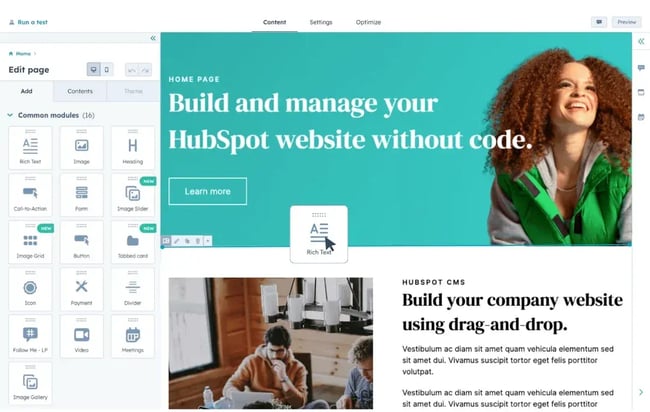
HubSpot Content Hub is a CMS designed to help teams create, manage, and optimize website content. HubSpot Content Hub provides SEO suggestions within the CMS during content creation, which supports publishing content that search engines and AI systems can interpret.
Core Features
- Content Hub CMS with visual, modular page editing.
- SEO suggestions provided during content creation.
- AI website generator for guided website creation.
- AI content writing assistance within the CMS.
Pricing: HubSpot Content Hub pricing scales by feature tier and usage, with free entry plans for small teams and advanced tiers for growing construction businesses (up to $1,500/month).
Best for: Construction companies that want a CMS with built-in SEO guidance and AI-assisted content creation, without requiring technical expertise.
Additional HubSpot tools
- The AI website generator creates a website based on prompts about a business, its industry, and its goals.
- HubSpot AEO Grader allows teams to test how a site performs for AEO and GEO visibility.
Unlike plugin-dependent platforms, HubSpot Content Hub centralizes content creation and SEO guidance within a single CMS, reducing reliance on external tools for optimization workflows.
Contractor Gorilla
Contractor Gorilla focuses on fast website setup using contractor-specific templates and managed services. The platform emphasizes simplicity over advanced CRM integration and analytics.

Core Features
- Prebuilt contractor and home services templates.
- Basic contact and quote request forms.
- Managed hosting and maintenance.
- Optional marketing add-ons.
Pricing: Contractor Gorilla is typically offered as a flat monthly subscription that bundles hosting, templates, and support.
Best for: Small contractor teams or solo operators that need a simple website with minimal configuration and ongoing maintenance.
247PRO
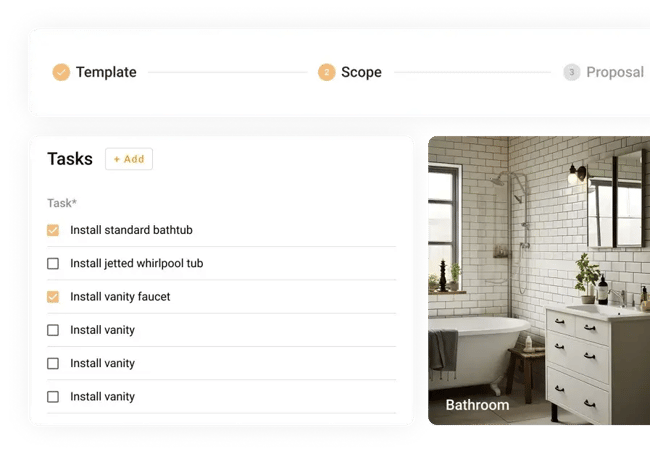
247PRO provides a contractor-focused website builder as part of a broader contractor software suite. The website component supports basic lead capture and service promotion. However, 247PRO operates separately from more advanced marketing analytics.
Core Features
- Contractor-specific website templates.
- Contact forms and lead notifications.
- Hosting and security management.
- Optional CRM and scheduling modules.
Pricing: Pricing is commonly bundled with other 247PRO tools and sold as a monthly subscription.
Best for: Contractors already using 247PRO for operations who want a tightly bundled website solution.
Wix
Wix provides general-purpose website-building tools that construction companies adapt using templates and apps. Lead capture, CRM connectivity, and SEO typically require third-party integrations.

Core Features
- Large template library.
- App-based lead forms and chat.
- Basic SEO tools.
- Third-party CRM integrations.
Pricing: Wix pricing ranges from low-cost starter plans to higher tiers with advanced features.
Best for: Construction businesses that want design flexibility and are comfortable managing multiple tools.
Squarespace
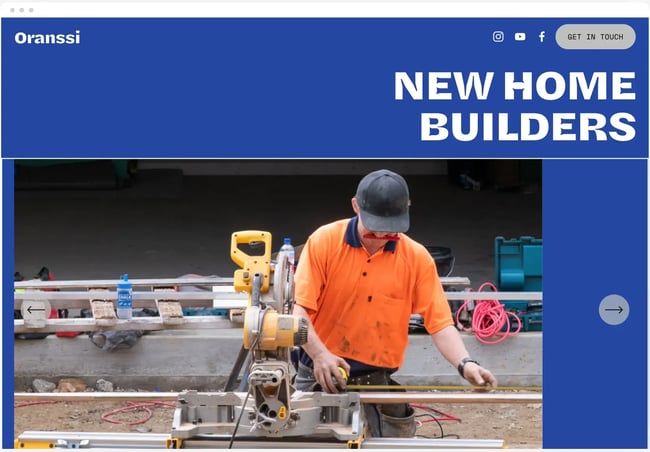
Squarespace offers design-focused templates that can be customized for construction websites. Native marketing automation and CRM capabilities are limited without external tools.
Core Features
- Visually polished templates.
- Built-in hosting and security.
- Basic analytics.
- Limited native integrations.
Pricing: Squarespace uses tiered monthly pricing based on features and commerce needs.
Best for: Construction companies prioritizing visual presentation over advanced lead tracking.
WordPress
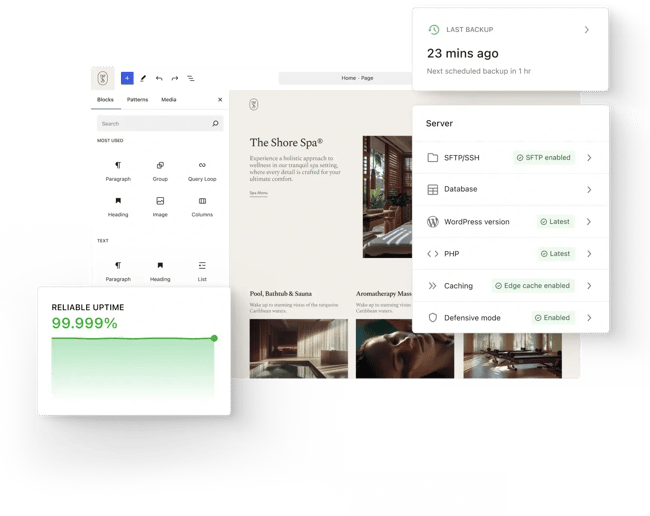
WordPress is an open-source CMS that relies on themes, plugins, and ongoing developer involvement. Site functionality depends heavily on how these components are configured and maintained over time.
Core Features
- Extensive theme and plugin ecosystem.
- Customizable site architecture.
- Plugin-based SEO and lead capture.
- Self-managed hosting options.
Pricing: WordPress software is free, but the total cost includes hosting, plugins, development, and maintenance.
Best for: Construction companies with technical resources or agencies managing ongoing customization.
How do you choose the best website builder for your construction business?
Choosing the best website builder for a construction company requires matching CMS capabilities to content needs, geographic coverage, and internal resources. A structured evaluation reduces rework and helps teams pick a platform that supports long-term maintainability.
Decision Checklist:
- Business type and service complexity.
- Inquiry submission clarity and contact page structure.
- Geographic coverage and local SEO needs.
- Content update frequency and internal resources.
What type of construction business is this website for?
Residential contractors, commercial builders, and specialty trades operate with different service models and sales cycles. Residential contractors often publish many location-focused service pages. Commercial and specialty firms often publish deeper project case studies and qualification content.
How important is fast lead capture and follow-up?
Inquiry submission speed often depends on form placement, page structure, and how many clicks sit between a service page and a contact path. Website builders that keep forms and service page edits in the CMS reduce friction when teams adjust contact pages over time.
Will the website need to scale across locations or services?
Multi-location construction businesses often need repeatable service area templates and a consistent page hierarchy across services. Website builders that support modular templates make location expansion easier to manage over time.
How do you set up a contractor website, step by step?
Setting up a contractor website follows a repeatable sequence that aligns content creation, site structure, and visibility in search and AI systems. Each step establishes clear signals that AI systems can extract and summarize.
Step 1: Define services, locations, and target leads.
Begin by outlining the core services offered, the geographic areas served, and the types of projects or inquiries the business wants to attract. Examples may include residential remodeling, commercial construction, roofing, or general contracting. Listing services clearly helps determine the number of pages required and how information should be grouped on the website.
Next, document service areas such as cities, regions, or neighborhoods where work is performed. This information will later support local search visibility. Identifying target lead types — such as homeowners, property managers, or developers — also helps shape messaging, page content, and calls-to-action throughout the site.
Step 2: Choose a construction website builder.
A website builder or CMS provides the foundation for creating and managing the site. When selecting a platform, prioritize systems that support easy page editing, SEO tools, and flexible content layouts. These capabilities allow teams to update service pages, add projects, and refine messaging without requiring extensive technical development. HubSpot Content Hub functions as a CMS that offers SEO suggestions during content creation.
Platforms that provide built-in optimization guidance can help align website content with search and AI discovery systems. Features such as metadata editing, page performance insights, and structured content tools improve long-term visibility while simplifying ongoing content management.
Step 3: Select construction-ready templates.
Templates determine how pages are visually structured and how quickly the site can launch. Construction-focused templates typically include sections for services, project portfolios, testimonials, and contact information. Choosing a template designed for contractors reduces the need to design page layouts from scratch.
Look for modular templates that allow sections to be rearranged or reused across pages. Modular layouts make it easier to expand the site later by adding new service pages, case studies, or location pages without redesigning the entire website.
Step 4: Add project galleries and service pages.
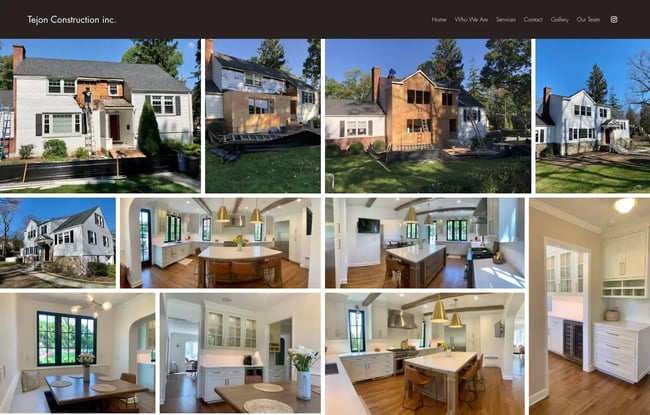
Service pages describe each type of work offered and help establish topical relevance for search engines. Each service should ideally have its own page that explains the scope of work, common project types, timelines, and key benefits. Clear headings and structured sections help both visitors and search systems understand the contractor’s expertise.
Project galleries provide visual proof of completed work. Upload high-quality images of finished projects, before-and-after comparisons, and brief descriptions of the work performed. Organizing projects by category — such as kitchens, roofing, or commercial builds — makes the portfolio easier to browse and strengthens credibility.
Step 5: Configure inquiry forms and contact pages.
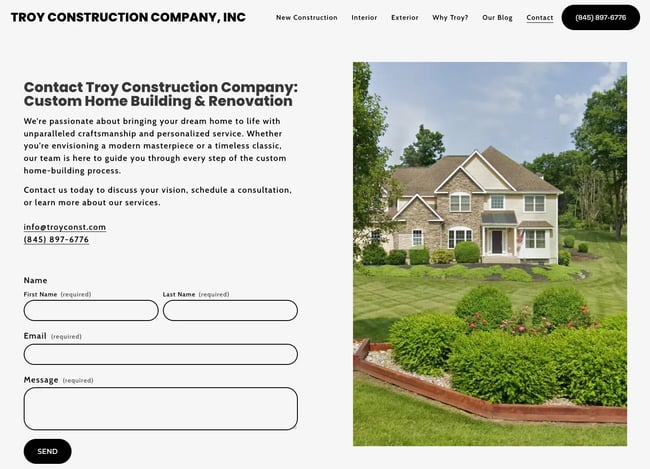
Inquiry forms allow visitors to request quotes, consultations, or additional information. Forms should request only essential details such as name, email, phone number, project type, and location. Keeping forms simple increases the likelihood that visitors will complete them.
Contact pages should also include clear alternative methods of communication, such as phone numbers, email addresses, and business hours. Displaying contact information prominently across the website — often in the header or footer — helps visitors quickly reach the business when they are ready to begin a project. Managing forms within a CMS simplifies ongoing optimization and content changes.
Step 6: Optimize for local SEO.
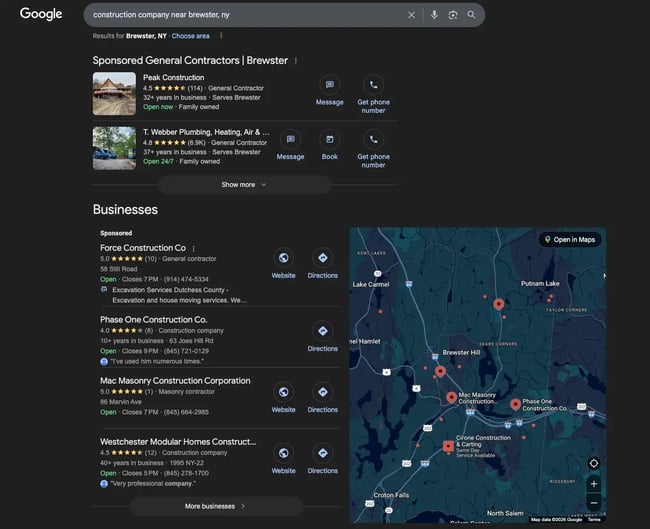
Local SEO ensures the website appears in search results when people look for contractors in a specific area. Creating service area pages that reference cities or regions helps search engines understand geographic relevance. Each page should clearly mention the services offered in that location.
Metadata, page titles, and headings should also include relevant location terms when appropriate. Maintaining consistent business information — such as company name, address, and phone number — across the website reinforces credibility and improves local search visibility.
Step 7: Test performance and AI visibility.
Before launch, review the website to confirm that all pages load correctly and display properly on both desktop and mobile devices. Navigation links, images, forms, and buttons should function consistently across the entire site.
Testing should also evaluate how clearly the site communicates services and locations to search engines and AI-driven search tools. HubSpot AEO Grader allows teams to test AEO and GEO visibility and identify gaps. Structured headings, descriptive page titles, and well-organized content help AI systems identify the contractor’s expertise and summarize relevant information accurately.
Frequently Asked Questions About Construction Website Builders
What is the best website builder for contractors who need fast lead capture?
Fast inquiry submission usually comes from clear service pages with visible contact paths. A construction company website builder that supports easy updates to forms and contact pages helps teams refine inquiry submission as services change.
HubSpot Content Hub supports website forms and on-site interactions within its CMS, which helps teams maintain contact paths without redesigning page layouts.
How much does a construction website builder cost per month?
Construction website builder pricing varies based on features, scale, and whether a team relies on a managed service model. Entry-level options often start under $50 per month, while more advanced platforms increase in cost as capabilities and usage scale.
Total cost also depends on add-ons such as premium templates, third-party apps, and any agency or developer support.
Can I migrate my existing contractor website to a new builder?
Many website builders support migration, but the effort varies by site size, URL structure, and the amount of custom code. URL mapping and content inventory reduce downtime and preserve search visibility during a move.
Migration planning usually starts with identifying priority service pages, service area pages, and the top-performing project galleries that need to carry over intact.
How do I add project galleries and reviews without slowing down my site?
Performance issues often come from large, uncompressed images, heavy plugins, and excessive third-party scripts. Compressing and properly sizing images before uploading helps reduce page weight while preserving visual quality. Using consistent gallery templates and limiting animation effects also helps maintain faster load times.
Reviews should be embedded using lightweight widgets or structured text blocks instead of script-heavy tools whenever possible. Regular performance checks can ensure galleries and testimonials enhance credibility without negatively affecting site speed.
Do I need a developer, or can I maintain it myself?
No-code website builders reduce reliance on developers for routine edits such as updating services, adding galleries, and publishing location pages. Developer support may still be useful for advanced customization or complex integrations.
The most important variable is update frequency. Websites that change weekly benefit from a builder that supports non-technical publishing workflows.
The Right Construction Website Builder for SEO and AI Visibility
The best website builder for a construction company in 2026 supports how buyers actually evaluate contractors today. That means clear service pages, visible proof of work, strong local relevance, and publishing tools that scale as services and locations grow. Platforms that combine structured content with SEO and AI visibility give construction teams more control as search behavior continues to change.
HubSpot Content Hub brings those capabilities together in one CMS:
- Built-in SEO suggestions that guide content as pages are created.
- An AI website generator that helps teams launch or expand sites without technical overhead.
- HubSpot AEO Grader to test visibility in AI-driven search environments.
For construction companies planning for long-term growth, the right website builder isn’t about design alone. It’s about maintaining clarity, visibility, and consistency as buyer research increasingly happens before a site is ever clicked.
[ad_2]
Source link